How they work
Why cold clay rises from the earth rather than glowing lava.
A cold volcano
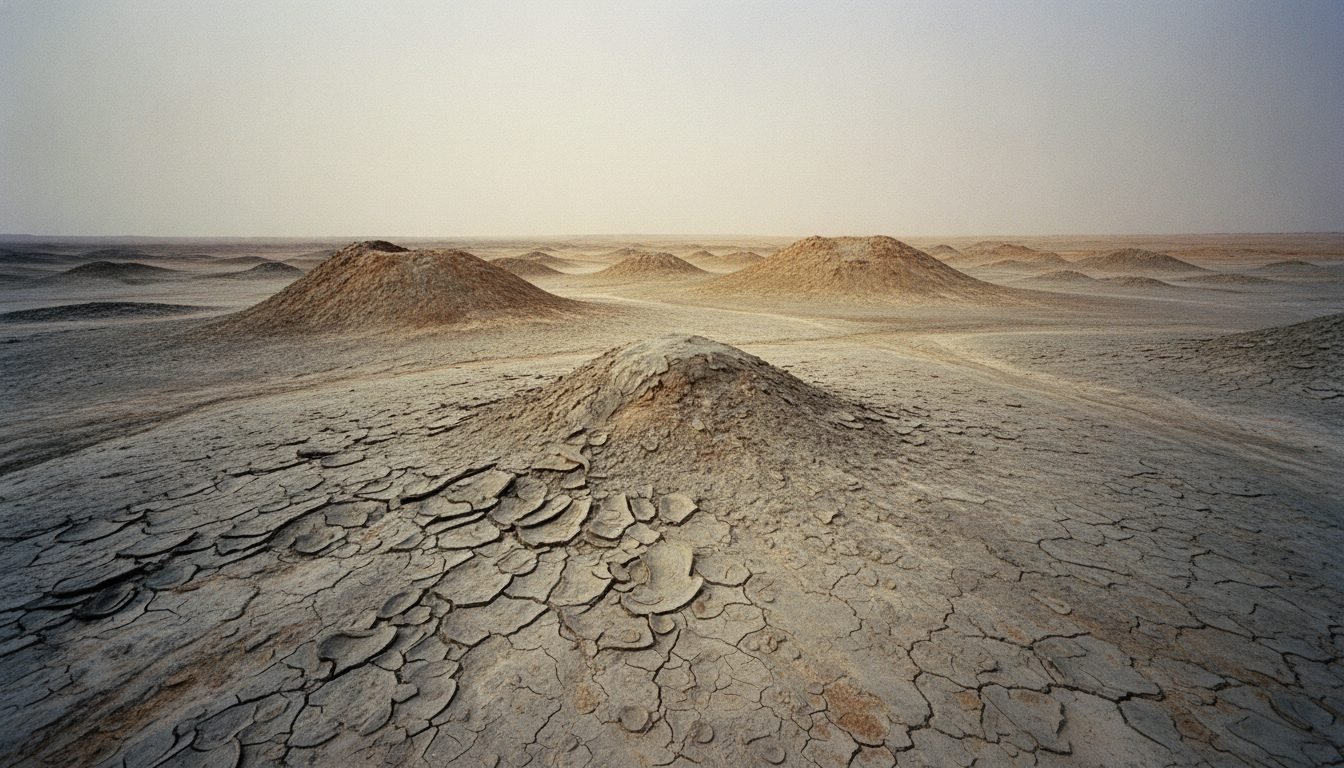
The chief difference between a mud volcano and an ordinary one is that it is cold. There is no magma and no glowing lava here: only gas, water and softened clay come out. Rising, this mixture pours from the vent and slowly spreads, gradually building up a cone of drying mud.
The driving force is gas, above all methane gathered in deep strata. Under enormous pressure it finds a way up through cracks, dragging water and clay with it. That is why mud volcanoes almost always sit beside oil and gas deposits — two manifestations of the same underground processes.
Gryphons, salses and craters
Gryphon
A small cone, from a palm to a person's height, from which liquid clay quietly bubbles.
Salse
A pool or puddle of cold liquid mud whose surface pops with bursting gas bubbles.
Crater
The main vent of a large volcano — a wide bowl from which the chief flow of mud and gas rises.
Cone and mountain
Over thousands of years flows of dried clay build a hill, and the largest volcanoes reach hundreds of metres in height.
A testing ground for science
Mud volcanoes interest more than geologists. Their landscapes and processes are so like the surface of Mars that scientists use the Azerbaijani fields as an earthly analogue of the Red Planet — here they test models of how Martian mud flows might look.
A mud volcano is a window into the depths of the earth: everything it brings up was born kilometres beneath our feet.